
Canopy Water Filter Review: Is It Worth It?
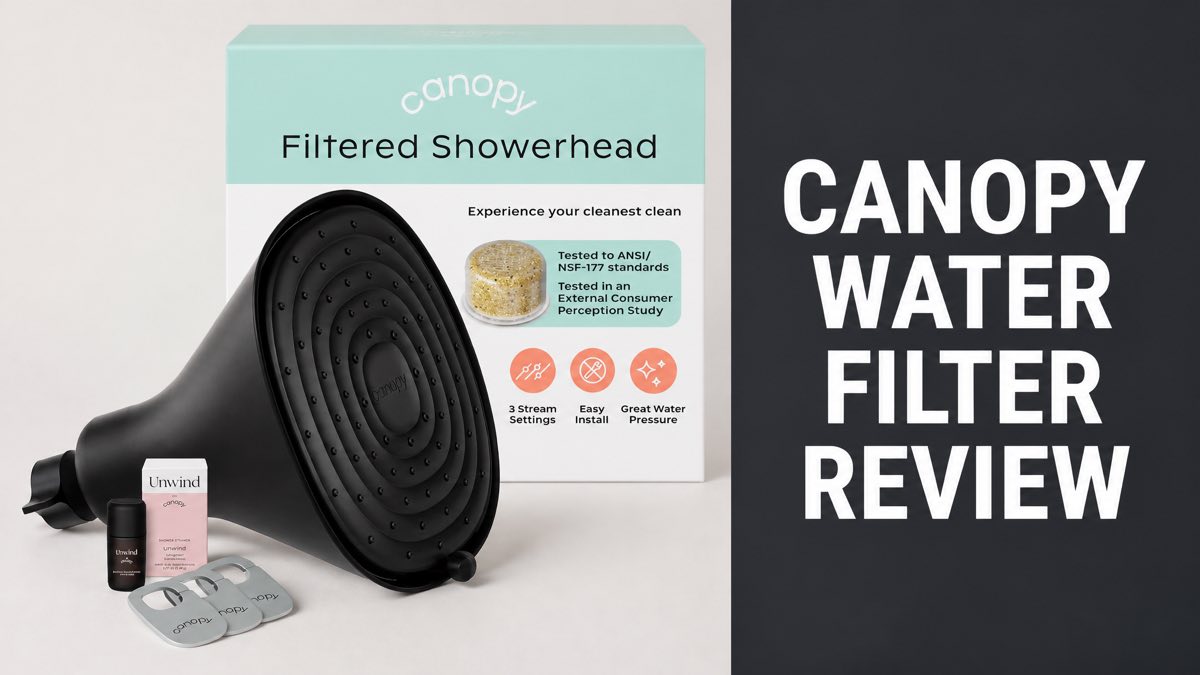
The Canopy water filter line covers a filtered showerhead, a faucet filter and a bath tub filter. Canopy is a home goods brand. The showerhead costs $150 and uses a three-stage cartridge that changes every 90 days, or about 180 showers. Canopy markets the line for gentler water on skin and hair.
Canopy's filters reduce chlorine and install in minutes. The cartridge lasts about 90 days, or roughly 180 showers. Independent scores stay modest, at 59 out of 100 for the shower filter. The NSF wording is tested-to, not certified. The filters do not soften hard water. Rival brands publish more test data.
Owners praise installation and pressure but flag slow service and a split connection. The review below covers cost, cartridge life, faucet fit, safety limits and how Canopy compares. Read on to learn exactly who should buy it and who should pick a different filter.
What Is the Canopy Water Filter?
The Canopy water filter is a family of shower, faucet and bath tub filters from the home goods brand Canopy. The best known model is the Filtered Showerhead, which pairs a showerhead with a three-stage cartridge. The brand sells the filters directly and through retailers.
Canopy also sells humidifiers, diffusers and air purifiers. The water line targets skin and hair care. Why? Chlorine in tap water dries skin and makes hair brittle, and the filters aim at that chlorine.
Canopy rates the showerhead cartridge for about 3,000 gallons (11,355 liters), or roughly 180 showers. The brand recommends a swap every 90 days. The swap schedule drives most of the ownership cost.
Which Canopy Water Filters Exist?
Canopy sells three water filter products that matter here: a filtered showerhead, a faucet filter and a bath tub filter. Each uses its own cartridge. The faucet cartridge does not fit the showerheads.
The showerhead is the flagship. The unit costs $150 as a one-time purchase, or $135 with a filter plan. The faucet filter lists at $124. A baby version of the bath tub filter also exists.
Independent scoring covers two of the three. Water Quality Rank scores the shower filter 59 out of 100. The bath tub filter earns 55 out of 100. The faucet filter has no score listed.
Canopy Water Filter Lineup:
| Product | Installs On | Independent Score |
|---|---|---|
| Filtered Showerhead | Shower arm | 59/100 |
| Faucet Filter | Bathroom faucet | Not scored |
| Bath Tub Filter | Bath tub | 55/100 |
How Does the Canopy Shower Filter Work?
The Canopy showerhead pushes water through a three-stage cartridge before it reaches the spray plate. The stages are granular activated carbon, KDF-55 copper-zinc media and calcium sulfite. Each stage targets a different group of contaminants.
Activated carbon from coconut shells handles chlorine. KDF-55 targets bacteria and fungi in the water. Calcium sulfite reduces heavy metals such as mercury and iron.
Contact time matters for carbon and KDF media. Shower water crosses the cartridge quickly. Rival brand Second Shower argues that limits results against chloramine, and Canopy lists chloramine without publishing a removal figure.
Does the cartridge choke the flow? Canopy sets the showerhead at 1.8 or 2.5 gallons per minute (6.8 or 9.5 liters), by state rules. Owners describe the pressure as steady.
How Long Does the Cartridge Last?
A Canopy shower cartridge lasts about 90 days. Canopy rates it for roughly 3,000 gallons (11,355 liters), which equals about 180 showers. Heavy use or heavy contaminant loads can shorten that window.
Swapping takes about a minute and needs no tools. Pull the old cartridge and drop in the new one. Late replacement cuts filtration, so a calendar reminder helps.
Hard water homes may need earlier swaps. Why? The cartridge works harder when mineral content runs high. A drop in spray strength is the signal to change it.
How Does the Canopy Faucet Filter Differ?
The faucet filter replaces the aerator on a bathroom sink and filters water at the spout. The design uses a micro mesh layer and an activated carbon block. Canopy says it reduces particles as small as 1 micron.
Canopy tests the cartridge to NSF-42 standards, which cover chlorine taste and odor. The unit adds a 360-degree swivel and a face fountain. The fountain tips the stream upward for face washing.
The filter measures 3 by 3 by 4 inches (7.6 by 7.6 by 10.2 centimeters). The unit weighs 1 pound (454 grams). Does it save water too? Canopy says it uses 66% less water than WaterSense standards. The cartridge also changes every 90 days.
Which Faucets Does It Fit?
The faucet filter fits standard round aerator threads on most bathroom faucets. Canopy names Moen, Kohler, Delta, Glacier Bay, Vola, Grohe and American Standard as compatible. Decorative or unusually shaped faucets may not fit.
The kit includes adapters for many thread sizes, a wrench, a ring sizer and a printed manual. Canopy also provides a personalized video guide. Installation usually takes under 10 minutes.
Faucet and shower cartridges do not swap. The faucet cartridge does not fit the Canopy showerheads. Buyers who want both products stock two cartridge types.
Faucet Filter Specs:
- Micro mesh plus activated carbon block
- Tested to NSF-42 standards
- Reduces particles down to 1 micron
- 360-degree swivel and rotating face fountain
- Cartridge replacement every 90 days
Does the Canopy Water Filter Work?
Yes. The filters reduce chlorine well, but independent scores stay modest. Water Quality Rank gives the shower filter 59 out of 100. Filter Standard rates the showerhead 8.4 out of 10 based on its published specs.
Chlorine removal is the strongest result. Performance on certain heavy metals runs weaker. Results depend on local water, and homes with heavy chlorine notice the most change.
Canopy's own consumer study offers cheerful numbers. Do they prove much? Not really. The study used 47 to 48 participants over 30 days, and results vary by person.
Skin and hair claims rest on personal experience. Some owners report calmer skin and softer hair within days to a week. No independent test in this research measured skin outcomes.
Is Canopy Tested to NSF Standards?
No. Canopy says its showerhead is tested to ANSI/NSF 177 but does not claim an NSF certification. Tested to a standard is not the same as certified under it. A rival comparison found no NSF listing for the showerhead.
The faucet cartridge is tested to NSF-42 standards. Canopy uses the same tested-to wording there. ANSI/NSF 177 is the standard for shower filters that cut free chlorine.
Buyers who want a listed product have another route. Jolie is the only showerhead in one seven-brand comparison with an NSF listing for free chlorine.
Does Canopy Soften Hard Water?
No. Canopy filters remove chlorine and some contaminants but do not soften hard water. Filter Standard lists a certified water softener as outside the product's scope. Marketing copy mentions minerals, yet no independent test here shows softening.
A softener or a whole-house system fits that job. A shower filter treats chlorine at the point of use. Buyers with scale on fixtures should plan for a different product.
Hard water is common. How common? Canopy says 85% of the US may have hard water. Scale makes the softening question matters so much.
What Do Canopy Reviews Say?
Owners mostly praise easy installation, steady pressure and softer-feeling hair and skin. Many describe a visible change within days. The faucet filter's face fountain draws repeated praise.
One owner with Louisiana water called their hair ten times better than with a regular showerhead. Another bought two showerheads, one for a master bath and one for a teen bathroom, and kept both.
Canopy's product page lists 2,653 reviews. Praise centers on softer feeling water, better taste and simple installation. Spa-like feel comes up often.
Scalp stories appear too. Do they mean a cure? No. One owner called it a real shift, not a miracle cure, with a calmer scalp after about a week.
What Complaints Come Up?
Complaints center on durability, customer service and subscription cancellation. The Better Business Bureau lists 73 complaints against Canopy in three years, 30 of them in the last 12 months. The count covers every Canopy product, humidifiers included.
One showerhead buyer said the connection point split after eight weeks and sprayed water across the bathroom. Canopy offered a replacement unit. The buyer wanted a refund, since the retailer, not Canopy, took the payment.
Another owner tried to cancel a showerhead filter subscription for more than a week with no confirmation. A third said the switch between showerhead and handheld modes seized after three months.
Canopy answered publicly and apologized for lost messages. Still, slow replies appear in several complaints. Service speed is a real risk factor.
How Does Canopy Compare to Jolie and Second Shower?
Canopy wins on design, spray settings and brand reach, while rivals lead on published test data. Canopy offers three stream settings. Jolie holds an NSF listing for free chlorine. Second Shower publishes chlorine and chloramine figures.
Second Shower prices its showerhead at $79 on subscription against Canopy's $150. The rival estimates Canopy's chlorine reduction falls to about 50% by day 60. The figure is a rival estimate, not a lab result for Canopy.
AquaBliss targets everyday chlorine and sediment reduction under $100. WaterChef's SF-7C pairs a certified cartridge with a handheld wand. WaterChef rates the cartridge for 10,000 gallons (37,854 liters), up to 6 months.
A 2026 comparison ranked Jolie and Sproos above Canopy for contaminant removal. Does that make Canopy a bad pick? No. Canopy works for general filtration, but it does not lead the market.
Canopy and Rival Filters:
| Brand | Standout |
|---|---|
| Canopy | Three stream settings and integrated design |
| Jolie | NSF listing for free chlorine |
| Second Shower | Published chlorine and chloramine figures |
| WaterChef SF-7C | Cartridge rated for 10,000 gallons |
Is a Cheaper Filter Enough?
Yes, for many households. A cheaper filter can handle everyday chlorine reduction at lower cost. AquaBliss's SF220 sits under $100, and Sonaki's PureFlow lists between $40 and $150. Canopy's extra cost buys design and spray settings.
The tradeoff is fit. Canopy cartridges only fit Canopy showerheads, so switching brands means buying a new showerhead. Inline filters add to an existing head instead.
Buyers who only want less chlorine smell can save money. Buyers who want an all-in-one showerhead with three spray modes get that from Canopy.
How Much Does Canopy Cost?
The Canopy Filtered Showerhead costs $150 one-time, or $135 with a filter plan. Replacement filters run about $25 every 90 days on subscription. The first year totals roughly $235 with the plan.
Later years cost about $100 for four filters, before tax. Rival Second Shower puts Canopy's first year at $270 using a higher filter price. Real totals depend on current pricing and plan terms.
The faucet filter lists at $124, and Canopy runs promotions on it. Shipping is free in the US. Orders usually process in three to five business days.
Canopy backs its devices with a 60-day return guarantee and a one-year warranty. Returns carry a catch. What is it? Filters and accessories are final sale, and a small handling fee applies.
Canopy Cost Breakdown:
| Item | Price | Notes |
|---|---|---|
| Filtered Showerhead | $150 ($135 with plan) | One-time versus filter plan |
| Replacement filter | About $25 | Every 90 days |
| Faucet Filter | $124 | Cartridge every 90 days |
| First-year showerhead total | About $235 | With filter plan |
Where Can You Buy Canopy?
Canopy sells direct at getcanopy.co and through major retailers. Amazon and Walmart carry the showerhead. Sephora, Bloomingdale's and Zola list the faucet filter.
Retail purchases carry a catch. Canopy told one buyer it could not refund a showerhead bought through a retailer, since the retailer collected the payment. Buying direct avoids that gap.
eBay lists third-party replacement cartridges. Check the model name before ordering, since showerhead and faucet cartridges do not swap.
Who Should Skip Canopy?
Canopy is a poor fit for buyers who want hard water softening, drinking water filtration or a certified product. Filter Standard flags the same limits. Whole-house needs also point elsewhere.
Homes with sidebar shower systems cannot use the fixed showerhead. The showerhead fits a standard 1/2-inch (1.3 centimeter) US shower arm.
Buyers who dislike subscriptions should read the cancellation complaints first. Canopy's lifetime warranty program requires an active aroma kit subscription. The standard warranty lasts one year.
Does Canopy Filter Drinking Water?
No. The Canopy showerhead treats shower water only and is not a drinking water filter. Filter Standard lists drinking water filtration as a mismatch. The faucet filter markets water for washing and sipping, but it targets bathroom sinks.
Canopy lists chlorine, chloramine, iron, manganese and zinc among the contaminants its faucet media reduce. Buyers who need health-grade drinking water treatment should look at certified systems.
Is the Canopy Water Filter Worth It?
Yes, with limits. Canopy is worth it for shoppers who want an attractive, easy filtered showerhead and accept modest independent scores. Canopy reduces chlorine, installs in minutes and keeps pressure steady.
It falls short on proof and service. The shower filter scores 59 out of 100. The NSF language is tested-to only. Complaints cite slow replies and a split connection.
Pick Canopy for design, three spray settings and a simple 90-day routine. Pick a rival for lower cost, published chloramine data or a listed certification.
Upkeep runs about $100 a year. Is that reasonable? Yes, if you value the simple routine and notice the change in your water.
What Are the Pros and Cons?
The pros are easy installation, three spray settings, steady pressure and a clear 90-day cycle. The cons are modest independent scores, no softening and uneven customer service. Weigh each against your own water.
The faucet filter adds a face fountain and a 360-degree swivel. Its cons are 90-day cartridge changes and limited fit on decorative faucets.
Pros:
- Tool-free installation in minutes
- Three stream settings
- Steady water pressure
- Clear 90-day replacement cycle
Cons:
- Modest independent scores
- No hard water softening
- Cartridges fit only Canopy products
- Slow customer service in some complaints
Pop Kitchen is a reader-supported platform. Purchases made through our links may earn us an affiliate commission at no extra cost to you.