
Culligan Water Filter Review: Is It Worth It?
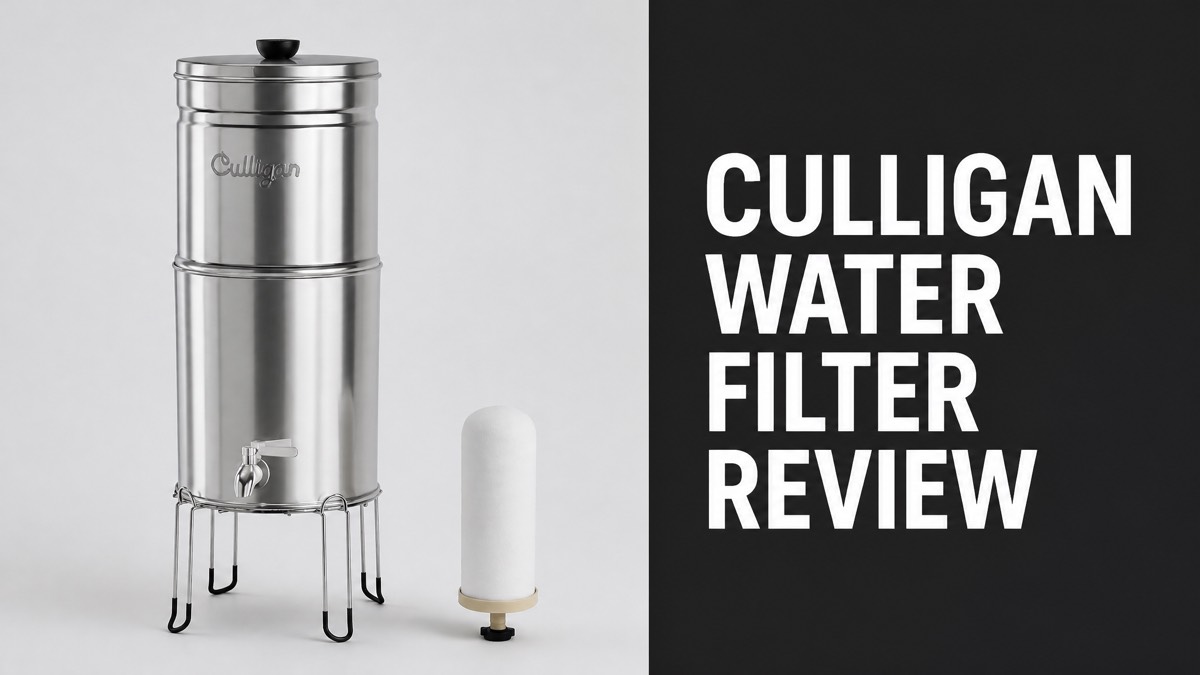
A Culligan water filter is a home drinking-water filter made by a 90-year-old water treatment company. The brand sells ZeroWater pitchers, MaxClear gravity systems, and under-sink reverse osmosis units. Each line targets different contaminants for different households. Pitchers fit fridges and gravity systems fit counters.
Culligan filters pull water through layered media that trap or swap out contaminants. They remove chlorine, lead, PFAS, and many metals. Reviews praise taste and easy setup. Owners complain about slow flow and filter costs. The MaxClear system wins on certification but loses on filter life against Berkey. Lab testers score ZeroWater 9.33 and MaxClear 8.55 out of 10.
The big picture is a trade. Buyers get certified results without plumbing and pay for them in speed and filter costs. Read on for lab numbers, safety checks, costs, and who needs to skip it. The final verdict weighs every pro and con. Then judge whether the trade fits your kitchen.
What Is a Culligan Water Filter?
A Culligan water filter is a home drinking-water filter made by Culligan, a 90-year-old water treatment company. The brand sells pitchers, countertop gravity systems, and under-sink units. Each line targets a different set of contaminants.
Culligan is an Illinois-based company founded in 1936. Its consumer filters fall into two families. Culligan with ZeroWater Technology covers pitchers and dispensers. Culligan with MaxClear Technology covers stainless steel gravity systems.
The brand also sells reverse osmosis units that mount under the sink. One homeowner chose the Aquasential Smart RO with Total Defense, which is certified for more than 90 contaminants. And a local Culligan rep runs a free in-home water test.
Which Culligan Water Filters Suit Home Drinking Water?
Culligan's pitchers, dispensers, and gravity systems cover most home drinking-water needs. ZeroWater pitchers hold 7 cups (1.7 liters) to 12 cups (2.8 liters). Dispensers stretch up to 52 cups (12.3 liters).
Here's the size breakdown. The Scout gravity system holds 2.25 gallons (8.5 liters) and suits one to three people. The Venture holds 3 gallons (11.4 liters) and suits households of four or more. Both need no plumbing or power.
Renters and apartment dwellers favor pitchers and gravity systems because neither needs plumbing. The Aquasential Smart RO is the permanent option, since it mounts under the sink.
Culligan Home Filter Options:
- ZeroWater pitchers (7 to 12 cups)
- ZeroWater dispensers (up to 52 cups)
- MaxClear Scout system (2.25 gallons)
- MaxClear Venture system (3 gallons)
- Aquasential Smart RO (under sink)
How Does a Culligan Water Filter Work?
Culligan filters pull water through layered media that trap or swap out contaminants. Pitchers and gravity systems use no electricity or water line. Why is that possible? Gravity alone moves water from the upper chamber to the lower one.
Let me break that down for ZeroWater. Pitchers run water through five stages. Activated carbon, KDF, and a mixed bed of ion exchange resin do the work. The resin swaps charged ions for hydrogen and hydroxyl ions. In plain English: nearly all dissolved solids come out.
MaxClear takes a different route. A ceramic shell catches microplastics and fine particles first. Activated carbon then reduces chlorine and organic matter. And a high-flow carbon block handles lead, PFAS, pharmaceuticals, and pesticides.
What Filter Media Do Culligan Filters Use?
Culligan filters use activated carbon in every line, paired with ceramic, KDF, or ion exchange resin. ZeroWater combines coal-based carbon, KDF, and resin. MaxClear combines coconut-shell carbon, a carbon block, and a ceramic shell.
Here's the thing about KDF: the copper-zinc alloy removes heavy metals and chlorine and keeps bacteria from growing inside the filter. Culligan's website doesn't list KDF in MaxClear filters. A company contact confirmed it to testers.
Replacement filters aren't interchangeable across lines. New Culligan ZeroWater elements don't fit legacy ZeroWater pitchers or dispensers. But MaxClear filters fit most gravity systems. Berkey, ProOne, Boroux, and AlexaPure units are on the list.
What Does a Culligan Water Filter Remove?
Culligan filters remove chlorine, lead, PFAS, and many metals, with results that vary by line. ZeroWater filters are certified for more than 25 contaminants. MaxClear filters hold certifications for 13 contaminants under NSF/ANSI standards 42, 53, and 401.
To be clear, IAPMO, an independent certifier, handled the testing for both lines. NSF 42 covers chlorine taste and odor. NSF 53 covers health effects such as lead and fluoride. NSF 401 covers emerging compounds such as pharmaceuticals and pesticides.
Certification is voluntary, so plenty of filters skip it. Why does that matter here? Both Culligan lines carry it. Water Filter Guru rates ZeroWater among the most comprehensively certified filters it has tested.
Does a Culligan Water Filter Remove PFAS and Lead?
Yes. A Culligan MaxClear filter reduces total PFAS and lead by about 99 percent in certification testing. Average results are 99.6 percent for total PFAS and 99.2 percent for lead at pH 6.5.
And here's the part most people miss: MaxClear also reduces chlorine by 99.4 percent and chloramine by 99.6 percent. Microplastics drop 96.5 percent. Wired and Water Filter Guru both note that no other gravity filter they tested holds that exact certification mix.
MaxClear Certified Reductions:
| Contaminant | Average Reduction |
|---|---|
| Total PFAS | 99.6% |
| Lead (pH 6.5) | 99.2% |
| Chlorine | 99.4% |
| Chloramine | 99.6% |
| Microplastics | 96.5% |
ZeroWater performs differently on PFAS. The certification claims 99 percent. But TechGearLab's spiked test water showed 87 percent total PFAS reduction and 85 percent for PFNA. Buyers near airports, military bases, or landfills want stronger protection.
Lead removal is the ZeroWater strength. TechGearLab measured 100 percent lead and arsenic removal and 98 percent uranium removal. For a real-world version, one owner with a lead service pipe saw lead fall from 9 ppb to zero after six weeks.
Does a Culligan Water Filter Remove Fluoride?
Yes. The ZeroWater line removes fluoride and holds an NSF 53 certification for it. Lab testing found 1.4 ppm fluoride in tap water, above the 0.799 ppm health guideline. The pitcher cut that to zero.
The MaxClear system also cut fluoride to zero in the same lab test. Is it certified for that? No. Culligan doesn't certify MaxClear for fluoride reduction, and one Scout owner confirmed that gap.
Short answer: buyers who need verified fluoride reduction pick ZeroWater, which carries the certification. Buyers in areas with unfluoridated water skip the question entirely.
What Do Culligan Water Filter Reviews Say?
Culligan filter reviews praise taste, certifications, and easy setup, but criticize slow flow and filter costs. Water Filter Guru scores the ZeroWater pitcher 9.33 out of 10 and the MaxClear system 8.55. Wired calls MaxClear the best-certified stainless steel filter it has tested.
TechGearLab scored the 8-cup ZeroWater pitcher 75 out of 100 and ranked it seventh of 13 filters. Metals and fluoride scored near the top. But upkeep cost scored just 3.9 out of 10.
The company itself draws mixed ratings. Culligan holds 3.0 stars across 566 ConsumerAffairs reviews. Of those, 48 percent are five-star and 45 percent are one-star. The ratings cover the whole company. Softeners and service count too.
What Do Owners Like?
Owners like the cleaner taste, quick setup, and stainless steel build. Several buyers noticed better-tasting water within days. One MaxClear owner called the water fresh and smooth. A Scout owner finished setup in under 30 minutes without tools.
The Scout ships with a stand, a stainless steel spigot, and a non-slip mat. And rival brands charge extra for those parts. Water Filter Guru rates the design 10 out of 10 for its minimal plastic.
Renters and small households like the no-plumbing design. One ZeroWater owner in a rented home called the pitcher a great option for the family. The pitcher assembles in under five minutes. And it needs no priming.
What Are the Common Complaints?
Owners complain most about slow flow and expensive replacement filters. A MaxClear system filters only 0.3 gallons (1.1 liters) per hour. How long does a full upper chamber take? Eight hours with three filters installed.
ZeroWater filters last only 20 gallons (76 liters). What does that cost? About $0.90 per gallon, the highest of any countertop filter Water Filter Guru tested. A few owners also report a charcoal or metallic taste late in the filter's life while the meter still reads zero.
Demineralized water is another trade-off. ZeroWater lowers pH from 7.6 to 6.6 and cuts calcium and magnesium to zero. Some drinkers find the water flat. And remineralization products add cost.
Warranty and returns draw complaints too. ZeroWater pitchers carry a 90-day warranty and the filters just 30 days. Culligan's returns language treats each case individually. Water Filter Guru calls it the most confusing among countertop brands it has reviewed.
Defects appear occasionally. One buyer reported a torn rubber stopper and a flow of one drip every 3 to 5 seconds. Another needed to adjust the spigot nozzle to stop leaks.
Common Complaints:
- Slow flow (0.3 gallons per hour on MaxClear)
- Short ZeroWater filter life (20 gallons)
- High filter cost per gallon
- Flat, demineralized ZeroWater water
- Short ZeroWater warranty (90 days)
- Confusing returns language
- Occasional defects
How Does Culligan Compare to Berkey and Other Filters?
The MaxClear system wins on certification and loses on filter life against Berkey. Culligan publishes full third-party results. The EPA issued a stop-sale notice on Berkey's classic black filters in 2023. Why? The agency said the antimicrobial claims made them unregulated pesticides.
Wired picked the Boroux Legacy over MaxClear as the best gravity filter for most people. Boroux filters can last up to a year. MaxClear still took Wired's best-certified title, but it filters slowly and costs more to maintain.
Pitcher and faucet rivals offer a different trade. TechGearLab's comparison gave PUR and Brita faucet filters a 10.0 PFAS score against 7.0 for ZeroWater. By comparison, the ZeroWater pitcher led on fluoride and nitrates.
TechGearLab's top scorer in that comparison was the APEC ROES-50 reverse osmosis system at 94 points. The ZeroWater pitcher scored 75 in the same comparison.
Which Costs Less to Run, Culligan Scout or Berkey?
The Culligan Scout costs less to buy but more to run than a Berkey. The Scout costs $229 with a container, one filter, a stand, and a stainless steel spigot. The Big Berkey costs $234 with no filters, no stand, and a plastic spigot.
Berkey add-ons narrow the gap, though. A stainless steel spigot adds $23 and a stand adds $50. Berkey recommends Phoenix filters at $120 for two. Fluoride filters add about $100.
Scout vs. Berkey:
| Item | Culligan Scout | Big Berkey |
|---|---|---|
| Upfront price | $229 | $234 |
| Filters included | One | None |
| Stand | Included | $50 extra |
| Spigot | Stainless steel | Plastic ($23 for stainless) |
| Filter replacement | About 6 months | One year or more |
Filter spend favors Berkey. MaxClear filters last about 6 months, so a daily user replaces them twice a year. One Scout owner estimates $146 per year in filters. Phoenix filters last closer to one year or more.
Is a Culligan Water Filter Safe?
Yes. Culligan filters carry independent IAPMO certifications to NSF/ANSI standards. Both lines passed testing for the contaminants Culligan claims to reduce. Both also hold NSF 372 certification for lead-free design.
ZeroWater pitchers use a BPA-free polystyrene filter housing and BPA-free polypropylene and ABS bodies. Plastic still raises a question about microplastics leaching. Is that proven? Pitcher leaching hasn't been widely studied. The glass dispenser cuts plastic contact, but the filter housing still sits in the filtered water.
MaxClear systems avoid most plastic. Testers found only a few small plastic parts, such as a silicone washer and filter brackets. Wired counts just a couple of silicone stoppers touching the system.
Why Did Dichloromethane Show Up in One Lab Test?
Water Filter Guru detected 6.51 ppb of dichloromethane in water filtered through a MaxClear system. The tap water had none. The solvent exceeds both the health guideline and the EPA goal, which are set at zero.
The same lab batch covered eight countertop filters. Only the MaxClear sample showed the solvent. Does that point to the filter? Testers doubt it. The test also found sulfate rising from 8.5 ppm to 70.1 ppm and magnesium rising 55 percent.
MaxClear filters passed NSF extraction testing for methylene chloride, another name for dichloromethane. One theory points to packaging materials. Water Filter Guru still recommends the unit and calls the result likely a one-off.
Here's a useful comparison: the ZeroWater pitcher tested clean. The same lab panel includes dichloromethane, and the pitcher test did not detect it.
How Much Does a Culligan Water Filter Cost?
Culligan water filters cost from about $25 for a pitcher to $229.99 or more for a gravity system. ZeroWater pitchers start at $24.99. MaxClear gravity systems start at $229.99. Size and sales change the final price.
Filter replacements drive the real cost. A ZeroWater filter lasts 20 gallons (76 liters) at about $0.90 per gallon. The smallest pack runs $18 per filter. Most households replace one every few weeks to four months.
MaxClear filters cost $78.99 each, or $60 each in a six-pack. Each lasts 50 gallons (189 liters), up to 6 months. What does the math say? $1.20 to $1.58 per gallon, the highest among gravity filters Water Filter Guru tested.
Replacement Filter Costs:
| Option | Filter Price | Capacity | Cost per Gallon |
|---|---|---|---|
| ZeroWater pitcher | $18 each (smallest pack) | 20 gallons (76 liters) | $0.90 |
| MaxClear single filter | $78.99 | 50 gallons (189 liters) | $1.58 |
| MaxClear six-pack | $60 each | 50 gallons (189 liters) | $1.20 |
Annual filter costs land near $160 for both lines. And Wired puts ceramic filters at $60 to $90 each. Buyers who add a second or third filter to speed flow pay that price for each one.
Is a Culligan Water Filter Worth the Price?
Yes. A ZeroWater pitcher offers strong value at roughly $25 upfront. Water Filter Guru found it removed every health-related contaminant in lab testing.
MaxClear value depends on your priorities. Certification, easy setup, and quality design score high. But filter cost and slow flow pull the score down. Water Filter Guru still recommends the unit.
Bottom line: the trade-off is simple. TechGearLab describes ZeroWater as near reverse osmosis-grade filtration without the installation, with ongoing costs that add up. Buyers who accept those costs get certified results without plumbing.
Who Should Avoid a Culligan Water Filter?
Culligan filters do not suit buyers who need fast, high-volume, or off-grid water. MaxClear systems filter slowly by design. Two or three gallons (7.6 to 11.4 liters) a day is the practical overnight limit, as Wired notes.
Buyers who dislike demineralized water skip ZeroWater. The filter strips calcium, magnesium, and sodium. Carbon-based filters such as Boroux keep those minerals, as Wired notes.
TechGearLab scored the ZeroWater pitcher 5.5 on microplastics. Why so low? Large pores let smaller particles through. Buyers with microplastics or PFAS concerns skip the pitcher, and the MaxClear system fits that need better.
Whole-house filtration is outside the Scout and Venture range. Neither suits emergency or wilderness use. Culligan sells whole-home systems separately.
Does a Culligan Water Filter Kill Bacteria?
No. Culligan MaxClear filters are not certified to purify untreated surface water. Lakes, rivers, and streams need a microbiological purifier. The Scout fits city tap water and well water instead.
Here's what the KDF media does: it keeps bacteria from growing inside the filter itself. The media protects the filter but doesn't disinfect water. Buyers with untreated sources need a separate purifier.
Culligan positions the Scout as a tap water improvement system, not an emergency purifier. Buyers planning for emergencies pick a different product.
Is a Culligan Water Filter Worth It?
Yes. A Culligan water filter is worth it for buyers who value certified results over speed and low upkeep. The ZeroWater pitcher suits buyers with metals, fluoride, or hard water concerns.
The MaxClear system suits buyers who want certified PFAS, lead, and microplastics reduction. Buyers who need fast flow, retained minerals, or low filter costs look elsewhere.
What Are the Pros and Cons of a Culligan Water Filter?
A Culligan water filter trades certified performance for speed and low running costs. Strengths include certifications, easy setup, and strong metals removal. Weaknesses include slow flow, high filter costs, and mineral-free water.
Testers who bought and ran the units still endorse them. Water Filter Guru scores ZeroWater 9.33 and MaxClear 8.55 out of 10. And Wired named MaxClear its best-performing and best-certified filter.
Pros:
- Lab-backed NSF/ANSI certifications
- No plumbing or power needed
- Quick setup
- Strong metals removal
- Minimal plastic in MaxClear systems
Cons:
- Slow MaxClear flow
- High filter costs
- Mineral-free ZeroWater water
- Short ZeroWater warranty
- Confusing returns language
Pop Kitchen is a reader-supported platform. Purchases made through our links may earn us an affiliate commission at no extra cost to you.