
Cuno Water Filter Review: Is It Worth It?
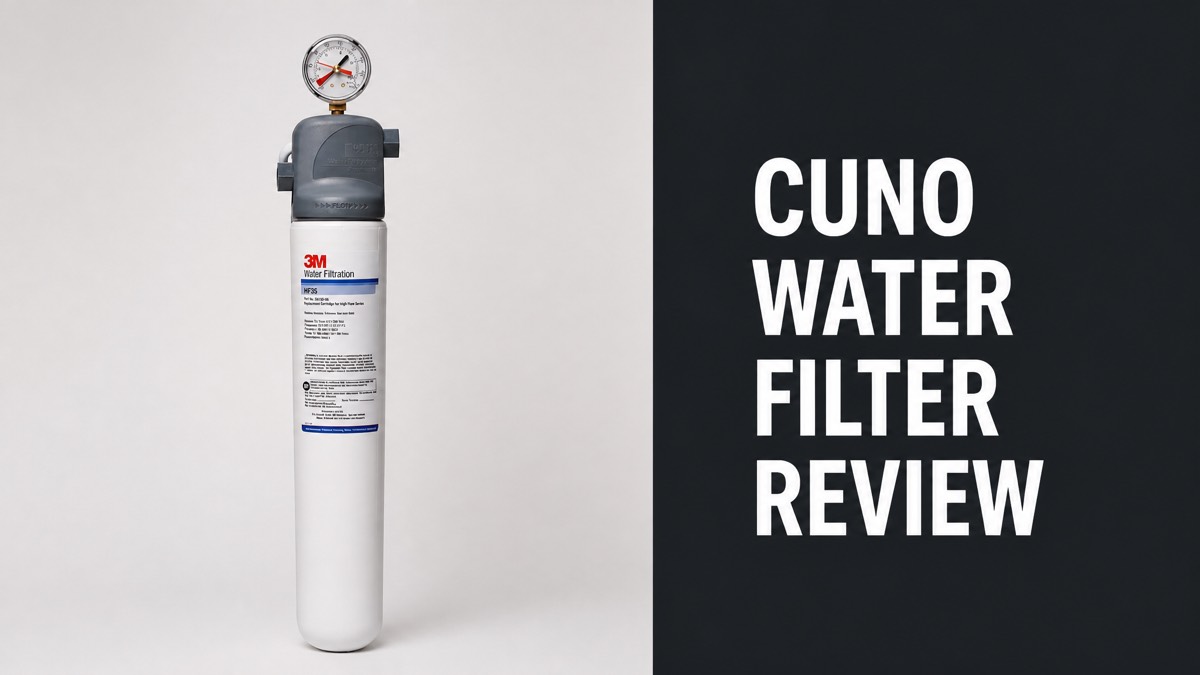
A Cuno water filter is a cartridge system from the Cuno brand. Cuno sells it under the Cuno, Aqua-Pure and Water Factory names. Solventum now makes the range after 3M bought Cuno in 2005. Foodservice parts built the brand first, and home buyers meet it as whole house, under-sink, faucet or reverse osmosis units.
The system pushes tap water through a rigid carbon block cartridge. The Aqua-Pure AP903 cuts over 85% of chlorine at up to 20 gallons per minute (75.7 liters per minute). The DWS1000 adds NSF claims for lead and cysts. The FaucetMate line covers kitchen taps. Buyers praise the clean taste, the sturdy build and the tool-free installs.
The limits matter too. SQC heads accept only 3M cartridges. Some models skip PFAS, sediment or indicator lights. The sections below cover models, removal claims, cost, replacement timing and where to buy. A final verdict then weighs the value for whole house and under-sink buyers.
What Is a Cuno Water Filter?
A Cuno water filter is a cartridge system from the Cuno brand. To be clear, Cuno sells the range under the Cuno, Aqua-Pure and Water Factory names. Whole house, under-sink, faucet and reverse osmosis units all exist.
Charles Cuno founded the company in 1912. The firm first made automobile products. So how did it become a filter brand? Cuno moved into filtration in the 1960s and listed on NASDAQ by 1996.
Cuno built its name on commercial and foodservice parts. What do those parts do? The HF, CFS and ICE series filter water for ice machines, coffee brewers and steamers. And the home lines grew from that base.
Retail listings count 242 Cuno products. For example, prices run from $68 to $358. The average price sits near $157.90.
Who Makes Cuno Filters Today?
Solventum now makes Cuno, Aqua-Pure and Water Factory filters. 3M bought Cuno in 2005. 3M later spun its water purification business off to Solventum.
The ownership chain explains the labels on store shelves. Many listings still read 3M Cuno, Cuno / 3M or 3M Aqua-Pure. Here's the thing: the labels differ, but the products come from one family.
Replacement filters follow the new owner. The correct replacement filters for all three brands are now Solventum parts. So, buyers match the part number on the old cartridge before ordering.
How Does a Cuno Water Filter Work?
A Cuno water filter pushes tap water through a rigid carbon block or graded density cartridge. The cartridge holds its shape under any water pressure. Porous walls trap particles without choking the flow.
Depth cartridges stack layers with finer pores than the layer before. Let me break that down: coarse layers catch large grit first. Fine layers then trap silt, rust and dirt. Natural white cellulose fiber forms the media.
Patented carbon block media reduces chlorine taste and odor. How much chlorine does the media cut? The Aqua-Pure AP903 line cuts over 85% of chlorine at 10 gallons per minute (37.9 liters per minute).
Micron ratings separate the cartridges. The AP110 and AP903 use 5 micron media. The DWS1000 uses 0.5 micron nominal media. By comparison, the DP390 and DWS2500T-CN reach 0.2 micron.
What Is the Sanitary Quick Change Design?
Sanitary Quick Change (SQC) is a twist-in cartridge head that swaps filters without tools, spills or contamination. The owner never touches the filter media. No filter wrench is needed.
Each cartridge change ends with a flush. How much water is that? Owners run at least 10 gallons (37.9 liters) through the system after every change. Only then does the water go to the tap.
The AP903 head uses stainless steel. A limited 25 year warranty backs the head. And the metal doesn't corrode, so the head outlasts many cartridges.
Which Cuno Water Filter Models Exist?
The Cuno whole house range centers on the Aqua-Pure AP900 series. The series offers three levels of filtration on SQC heads. The single-cartridge AP903 handles up to 20 gallons per minute (75.7 liters per minute).
Under-sink buyers choose between the DWS1000, the DWS2500T-CN and the single-stage Easy Complete. The DWS1000 runs two stages. But the DWS2500T-CN filters to 0.2 micron absolute and adds an LED indicator.
FaucetMate systems treat kitchen tap water. The four models are the FM-2 CTO, FM-2 Lead Plus, FM-350 DWS and FM DWS 1500. NSF International certifies them, and each delivers 0.6 gallons (2.3 liters) per minute.
The Water Factory SQC 3 HF is a three-stage under-counter reverse osmosis unit. What comes in the box? The kit adds a 2 gallon (7.6 liter) tank, an air gap long-reach faucet and installation parts. NSF certifies the system.
Commercial lines include the HF25-S, CFS117 and AP110 cartridges and the DP390 dual port system. The DP390 filters to 0.2 micron at 15 gallons per minute (56.8 liters per minute). These parts serve ice, beverage and steam equipment.
Cuno Models at a Glance:
| Model | Type | Key Spec |
|---|---|---|
| AP903 | Whole house | 20 gpm (75.7 lpm), 100,000 gallons |
| DWS1000 | Under-sink | 0.5 micron nominal, 625 gallons |
| DWS2500T-CN | Under-sink | 0.2 micron absolute, 750 gallons |
| FM DWS 1500 | Faucet | 0.6 gpm (2.3 lpm), 1,500 gallons |
| SQC 3 HF | Reverse osmosis | Three stages, 2 gallon (7.6 liter) tank |
What Does the Aqua-Pure AP903 Whole House System Offer?
The AP903 filters a whole house at up to 20 gallons per minute (75.7 liters per minute). One cartridge lasts 100,000 gallons (378,541 liters) or one year. The media is rated at 5 micron.
The AP903 weighs 10.1 pounds (4.6 kilograms). The housing measures 28.06 by 6.31 by 6.63 inches (71.3 by 16 by 16.8 centimeters). And a stainless steel head carries a limited 25 year warranty.
A retailer lists the AP903 at $401.61 against a $557.80 market price. But the housing ships without a cartridge. Drop-in cartridges sell separately.
Flow and reduction claims vary with the cartridge installed. Bottom line: chlorine taste and odor reduction remains the main job.
What Does the Aqua-Pure DWS1000 Under-Sink System Offer?
The DWS1000 filters drinking water in two stages to 0.5 micron nominal. NSF/ANSI Standards 42 and 53 cover chlorine taste and odor, particulates, cysts, lead, MTBE, turbidity and VOCs.
Flow runs 2.3 liters (0.6 gallons) per minute through a 1/4 inch (0.64 centimeter) tube. The two cartridges last 625 gallons (2,366 liters) or six months. What tracks that life? An automatic shutoff water meter tracks the cartridge life.
Consumer Reports tests the Aqua-Pure AP-DWS1000 for flavor and odor reduction, flow rate and clogging. The testers list it at $459.63 with a yearly running cost of $323. And they record no NSF certification for PFAS reduction.
US authorized dealers sell the DWS1000 with a faucet for $289. By comparison, the $459.63 listing sits $170.63 higher. Seller pricing varies widely across listings.
What Does a Cuno Water Filter Remove?
A Cuno water filter reduces chlorine taste and odor first. The AP903 line cuts over 85% of chlorine at 10 gallons per minute (37.9 liters per minute). Carbon block media does the work.
Certified models add health claims. For example, the DWS1000 carries NSF/ANSI claims for cysts, lead, MTBE, turbidity and VOCs. The FM-350 DWS adds pesticides and MTBE. The FM-2 Lead Plus covers lead and cysts.
Main Reductions:
- Chlorine taste and odor
- Lead
- Cysts
- MTBE
- VOCs
- Turbidity
- Pesticides on the FM-350 DWS
- Mercury and heavy metals on the DWS2500T-CN
Sediment cartridges target particles. What does the CFS117 pre-filter handle? The CFS117 pre-filter filters taste, odor and sediment to 5 micron. And the CFS117-S version adds scale.
Here is what stands out: the DWS2500T-CN claims mercury and heavy metal reduction. Its absolute rating reaches 0.2 micron at 95% efficiency.
What Does a Cuno Water Filter Not Remove?
An AP903 setup does not treat fungi, viruses, bacteria or fluoride. The 5 micron rating misses small particles. Buyers with those concerns need a second system.
The bad news? Consumer Reports lists no NSF certification for PFAS reduction on the AP-DWS1000. Buyers worried about PFAS need a different filter. The chlorine and lead claims remain intact.
The FM-2 CTO makes the narrowest claim. What does the model treat? Chlorine, taste and odor only. Lead, cysts, pesticides and MTBE fall outside the claim.
Not Covered:
- Fungi
- Viruses
- Bacteria
- Fluoride
- PFAS on the AP-DWS1000
- Sand, rust and dust on the reviewed AP903 setup
Cartridges built for sediment alone leave chlorine, cysts and pesticides untreated. The reviewed AP903 setup also left sand, rust and dust alone, and those homes add a sediment stage.
What Do Cuno Water Filter Reviews Say?
Cuno water filter reviews average 4.7 out of 5 stars across 238 buyer ratings. The score points to steady satisfaction across the product line.
Single products vary more. The HF25-S holds 4.3 out of 5 stars from 11 ratings. So what's the split? Five-star scores make up 82% of them, and one-star scores make up 18%.
Cuno ranks as a leading brand in commercial and industrial filtration. But home whole house use is a weaker fit, because the line aims at sediment, taste and odor. Cuno prices rarely undercut rival brands.
Feedback on the DWS1000 is mixed in tone. The good news? Water tastes great once installed, and the quarter-turn faucet valve doesn't leak. The bad news? The supplied fitting fails on some sinks.
What Do Buyers Like?
Buyers praise the clean taste of the filtered water. Carbon media cuts chlorine taste and odor. DWS1000 owners report that the water tastes great.
The AP903 earns praise for build quality, capacity and flow. Installation needs no tools. And the stainless head resists corrosion. The price stays affordable for a whole house unit.
SQC cartridges change without spills. In fact, owners of the AP810 replacement cartridge report that the part works great in the AP801 large diameter housing.
What Are the Common Complaints?
The DWS1000 draws complaints about installation fittings. The supplied connection doesn't fit every sink. One owner needed a call to customer service and a couple of trips to the store for the right fitting.
The AP903 draws complaints about feedback. Why? No lights, dials or stickers show the cartridge status. So owners track the change date on their own.
Cost and fit draw the rest of the criticism. Cuno home systems rarely undercut rivals on price. And the AP903 targets chlorine, so homes with sediment or health concerns need more.
Cuno vs Everpure: Which Is Better?
Everpure uses bayonet heads that accept original or compatible cartridges. Foodservice cost comparisons put an Everpure head at $100-$300 and a cartridge at $60-$180.
Cuno heads use the SQC valve-in-head design, which accepts only 3M cartridges. By comparison, a head costs $100-$350 and a cartridge costs $60-$200. Both brands call for a change every six months in foodservice use.
Cuno vs Everpure:
| Feature | Everpure | Cuno 3M |
|---|---|---|
| Head price | $100-$300 | $100-$350 |
| Cartridge price | $60-$180 | $60-$200 |
| Change interval | Six months | Six months |
| Generic cartridges | Widely available | Practically none for SQC heads |
| Supply lock-in | Low | High |
Consumer Reports lists the Everpure H-1200 from $696.72. The Aqua-Pure AP-DWS1000 lists at $459.63. So, the Cuno system costs $237.09 less.
Budget under-sink rivals cost far less up front. For example, the Culligan US-EZ-4 starts at $92.96. The Aquasana Claryum 2-Stage starts at $106.24. The Brondell Coral UC300 starts at $151.99.
Which Cuno Heads Lock You Into Cuno Cartridges?
SQC heads lock owners into Cuno cartridges. No credible generic market exists for the valve-in-head interface. Supply lock-in rates high on the SQC platform.
Drop-in housings stay more open. Compatible replacements exist for the Aqua-Pure AP217 and Cuno AP200 system from $39.78. And third-party makers also list systems compatible with the AP903.
Cartridges drive the cost of ownership. In foodservice, cartridges make up 85% to 95% of five-year filtration spend. Think of it this way: a lock-in on the cartridge is a lock-in on that bill.
How Much Does a Cuno Water Filter Cost?
A Cuno water filter costs $68 to $358 across the listed range. The average sits near $157.90 across 242 items. Whole systems cost more than single cartridges.
System prices climb quickly. The AP903 sells for $401.61. The DWS1000 sells for $289 with a faucet at authorized dealers. By comparison, single commercial parts cost less, such as the CFS117 pre-filter at $71.
Cuno Price Snapshot:
| Item | Price |
|---|---|
| AP903 whole house system | $401.61 |
| DWS1000 with faucet at authorized dealers | $289 |
| AP-DWS1000 listed by Consumer Reports | $459.63 |
| CFS117 pre-filter | $71 |
| AP217-compatible replacement filter | From $39.78 |
Running costs add up. Consumer Reports lists $323 a year for the AP-DWS1000. And cartridge spend, not hardware, drives that figure.
How Often Do Cuno Cartridges Need Replacing?
Cuno cartridges need replacing every six to twelve months in most setups. The AP903 cartridge lasts 100,000 gallons (378,541 liters) or one year. Actual water use varies, so volume matters more than the calendar.
The DWS1000 cartridge pair lasts 625 gallons (2,366 liters) or six months. But the DWS2500T-CN lasts 750 gallons (2,839 liters), usually six to nine months, with a 12 month maximum.
FaucetMate cartridges rate by volume. For example, the FM-350 DWS lasts 350 gallons (1,323 liters). The FM-2 Lead Plus lasts 500 gallons (1,893 liters). The FM DWS 1500 lasts 1,500 gallons (5,678 liters), and the FM-2 CTO lasts 2,500 gallons (9,464 liters).
Foodservice ice service replaces its cartridges every six months. Commercial users track that schedule per filter position.
Where to Buy a Cuno Water Filter?
Authorized 3M dealers sell genuine Cuno systems in the United States. The DWS1000 comes with a faucet from those dealers. The AP903 also ships through a 3M Strategic Distributor channel.
Specialist filter stores, home improvement chains and online marketplaces also carry the range. Genuine OEM parts get promoted for safety, reliability and performance. And compatible parts sell cheaper beside them.
So, replacement orders follow the Solventum name. Cuno, Aqua-Pure and Water Factory filters all trace to Solventum today. Part numbers on the old cartridge confirm the match.
Is a Cuno Water Filter Worth It?
Yes. A Cuno water filter earns its price for chlorine reduction at high flow. Certified under-sink models add NSF claims for lead and cysts. The line isn't a complete health filter.
Bottom line: the AP903 is the value pick for whole house chlorine removal. The DWS1000 suits buyers who want NSF claims and a water meter. Health protection stays partial on both.
The catch is cartridge lock-in. SQC heads accept only 3M cartridges, and cartridges dominate ownership cost. Buyers who price five years, not day one, see the true cost.
What Are the Pros and Cons?
The pros of a Cuno water filter center on build, flow and certified claims. Stainless steel heads carry a 25 year limited warranty. Tool-free installs, NSF claims and large capacities round out the list.
Pros:
- Stainless steel head with a 25 year limited warranty
- High flow up to 20 gpm (75.7 lpm) on the AP903
- Tool-free SQC cartridge changes
- NSF claims on certified models
- Large cartridge capacity up to 100,000 gallons
The cons center on lock-in and gaps. SQC heads limit cartridge choice. The AP-DWS1000 lacks a PFAS certification. And the AP903 lacks indicator lights, while some sink fittings don't fit.
Cons:
- SQC heads accept only 3M cartridges
- No PFAS certification on the AP-DWS1000
- No indicator lights on the AP903
- Supplied sink fittings do not fit every sink
- Chlorine-only scope on some cartridges
Pop Kitchen is a reader-supported platform. Purchases made through our links may earn us an affiliate commission at no extra cost to you.