
Delta Water Filter Review: Is It Worth It?
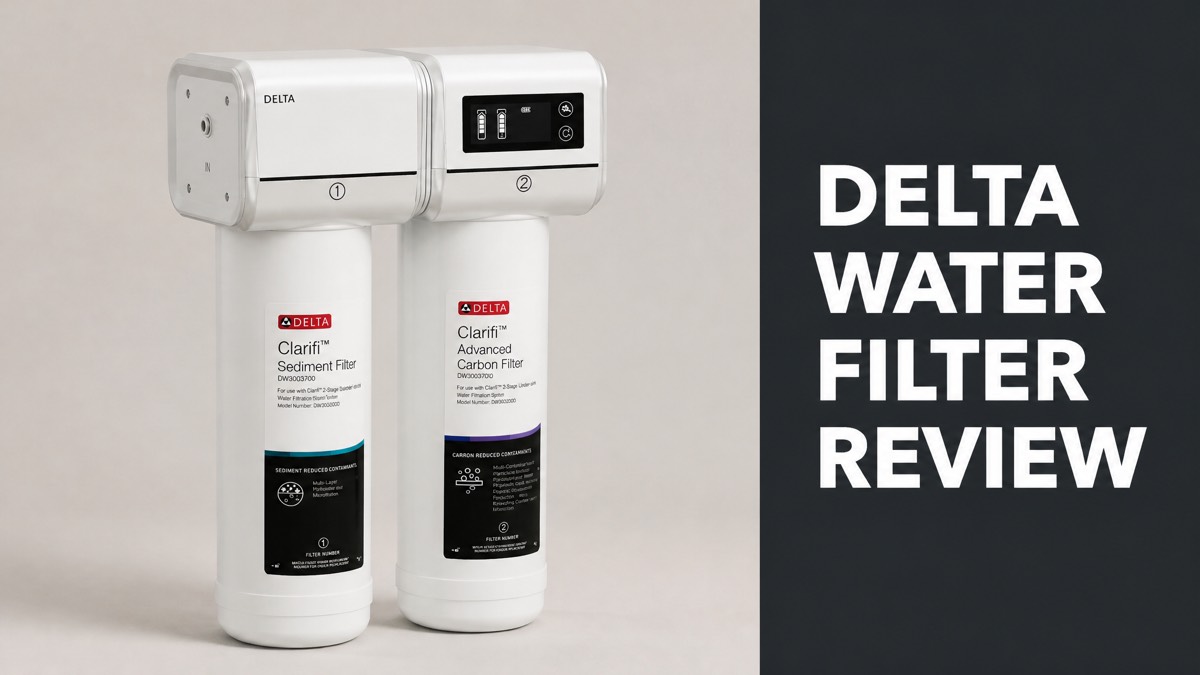
A Delta water filter is a Clarifi under-sink drinking-water system from Delta Faucet that cleans tap water at the home kitchen sink. The line includes a tankless six-stage reverse osmosis model, a two-stage system and a high-flow carbon unit. Prices run from $215 to $1,142 depending on the model.
The reverse osmosis model is certified for more than 90 contaminants such as PFAS and lead, and its spec sheet lists a 91.1 percent fluoride reduction. Filters twist in without tools, change in under a minute and last one to two years per cartridge. Owners praise the taste and the compact fit, while price, water use and bulk draw complaints.
Certification comes from IAPMO R&T Lab testing against NSF standards. The review covers the models, the costs, the complaints and the installation. The verdict weighs those strengths against the system cost and the extra faucet, then names the buyers who skip Delta before they place an order.
What Is a Delta Water Filter?
A Delta water filter is a drinking-water system from the Delta Faucet Clarifi line. The systems install under the kitchen sink and treat tap water before it reaches the glass. The flagship reverse osmosis model is certified to reduce more than 90 contaminants.
Delta sells three drinking-water formats. The Tankless 6-Stage Reverse Osmosis system, the 2-Stage Advanced system and the High Flow High Capacity system share the Clarifi name. So how do they differ? Each one targets a different budget and a different list of contaminants.
Delta also sells Clarifi shower filters. These attachments cost $78.45 to $271.30 and treat chlorine and sediment at the shower head. To be clear, shower filters form a separate category, so this review focuses on the three drinking-water systems.
Which Delta Water Filters Exist?
Delta sells three under-sink water filters: the Tankless 6-Stage RO (model DWQ1001012), the 2-Stage Advanced (DWQ3502020) and the High Flow High Capacity (DWQ3501510). Prices run from $215 to $1,142. Here's the catch: the RO system is the most thorough and also the most expensive.
The Tankless RO system uses three cartridges and adds an optional seventh stage. The unit is 6-1/4 inches (15.9 cm) wide, and the filters last two years. The system needs a separate beverage faucet and lists at $1,142.
The 2-Stage Advanced system pairs a sediment filter with a carbon filter. The system reduces 72 contaminants and lasts one year or 1,100 gallons (4,164 liters). An LCD screen reports filter and battery status. The price is $365.
The High Flow High Capacity system is a carbon unit that skips the second faucet. The unit runs on the main kitchen faucet and weighs 5.51 pounds (2.5 kg). The price is $215, and the filter lasts one year or 10,000 gallons (37,854 liters).
Delta Water Filter Models:
| Model | Price | Filter Life |
|---|---|---|
| Tankless 6-Stage RO | $1,142 | 2 years |
| 2-Stage Advanced | $365 | 1 year or 1,100 gallons |
| High Flow High Capacity | $215 | 1 year or 10,000 gallons |
How Does a Delta Water Filter Work?
A Delta reverse osmosis filter pushes tap water through a pre-filter, an RO filter and a carbon filter. Three cartridges deliver six filtration stages. The design has no storage tank, so filtered water flows fresh on demand. A self-flushing feature prevents stagnation.
Wasted water is the usual RO complaint. Does Delta fix it? The Clarifi system answers with a 2:1 filtered-to-waste ratio, against an average of 1:4 for tanked systems. Delta calls the design 87.5 percent more efficient.
Now, the carbon models work differently. Water passes through sediment and carbon stages on the cold line. The High Flow unit connects to the main kitchen faucet, so no dedicated spout is needed.
Last, electronics track filter life. Indicator lights and audible alerts flag a due change. The carbon models also sound a low-battery alert. The RO system lists a 222-watt rating.
What Does Each Filter Stage Remove?
The pre-filter catches particles before they reach the RO filter. Why bother? Early particle removal protects the membrane from clogging. A clear membrane keeps the system running at full efficiency.
The RO and carbon filters handle the dissolved contaminants. Together the six stages reduce chlorine, chloramine, microplastics, PFAS, lead, arsenic, nitrates and pharmaceuticals. The carbon stage targets chlorine taste and odor.
Contaminants the RO System Reduces:
- Chlorine and chloramine
- Microplastics
- PFAS and lead
- Arsenic and nitrates
- Pharmaceuticals
The optional remineralizer adds a seventh stage. Reverse osmosis strips calcium, magnesium and electrolytes along with the contaminants. What fixes that? The cartridge returns those minerals to the water and improves taste and pH.
What Are the Benefits of a Delta Water Filter?
A Delta water filter delivers broad contaminant reduction in a compact under-sink footprint. The RO system is certified for more than 90 contaminants. The tankless design frees cabinet space that a tank would fill.
Let me explain: space savings matter in a crowded cabinet. Delta says the tankless design saves over 60 percent of the space a tanked system uses. The unit is about the size of a desktop computer tower.
Bottle waste drops too. How much? Delta claims the High Flow system saves up to 5,000 water bottles per year of filter life. The claim applies to one 1-year filter.
And maintenance stays simple. Filters twist and lock into place without tools, and each change takes under a minute. The RO and carbon filters last two years, so one session covers both.
Main Benefits:
- Broad contaminant reduction
- Tankless space savings
- Tool-free filter changes
- Two-year RO filter life
Does a Delta Water Filter Remove PFAS and Lead?
Yes. The Tankless RO system is certified to reduce PFAS and lists a 99.3 percent lead reduction. The spec sheet also lists 99.97 percent copper reduction and 96 percent chlorine reduction.
The 2-Stage Advanced system also targets lead. The system reduces 72 contaminants. The list covers lead and PFOA/PFOS, and the unit holds NSF 42, 53, 372 and 401 certifications.
But the High Flow system makes narrower claims. Its certifications (NSF 42, 372 and 401) cover microplastics and chlorine taste and odor. Delta doesn't list lead or PFAS for this model.
Lead and PFAS Claims:
| Model | Lead | PFAS |
|---|---|---|
| Tankless RO | 99.3 percent reduction | Certified reduction |
| 2-Stage Advanced | Reduced | PFOA/PFOS reduced |
| High Flow | Not listed | Not listed |
Does a Delta Water Filter Remove Fluoride?
Yes. The Tankless RO system lists a 91.1 percent fluoride reduction on its spec sheet. The reverse osmosis stage does the work.
The carbon models list no fluoride claim. The 2-Stage and High Flow certifications cover chlorine, microplastics and contaminants such as lead, not fluoride. Sediment and carbon media don't target fluoride.
Here's the thing: fluoride decides the model. A buyer who wants it reduced needs the RO system, the only Clarifi format with a fluoride figure. Carbon buyers accept that fluoride stays in the water.
What Do Delta Water Filter Reviews Say?
Delta water filter reviews lean positive but rest on small sample sizes. The Tankless RO system averages 4.3 out of 5 across 67 retail ratings. Delta's own product page shows 4.0 across 40 ratings.
In plain English: the pattern is consistent. Owners praise the taste, the compact fit and the easy installation. Complaints center on the price, the water usage, the bulk of the unit and the cost of a separate faucet.
Small counts limit confidence. How thin is the base? Sixty-seven ratings for a system that lists at $1,142. The High Flow model shows a single 5-star rating at one retailer.
What Do Owners Like?
Owners praise the taste, the easy installation and the small footprint. One owner calls the water much better than what the refrigerator filter produced. Another says the water tastes great.
And installation earns real credit. One owner replaced a leased RO unit that cost $35 a month. The job took about 45 minutes, and Delta's installation video on YouTube helped with the steps.
Daily use stays quiet. Owners report low noise, a unit that fits easily under the sink and little upkeep beyond filter swaps.
What Are the Common Complaints?
The loudest complaint is price. Owners call the RO system expensive, and the cost climbs once the required beverage faucet joins the order.
Water usage draws criticism despite the 2:1 ratio. One owner describes consumption as high. Why does that happen? Reverse osmosis always sends some water to the drain, and the Clarifi system reduces that share without removing it.
Pay attention to this: fit takes planning. The unit stands about 15-13/16 inches (40.2 cm) tall and may be big for a cramped cabinet. Owners advise confirming the space before buying.
Common Complaints:
- High price
- Water usage
- Bulky unit
- Separate beverage faucet cost
Is a Delta Water Filter Safe?
Yes. A Delta water filter is tested by a third-party lab and certified to NSF standards. IAPMO R&T Lab tested the RO system against five NSF standards plus ASSE 1086.
To be clear: operating limits apply. The RO system accepts feed water from 41 to 100 degrees F (5 to 38 degrees C) at 20 to 80 psi (138 to 552 kPa). The Delta beverage faucet handles cold water only.
Upkeep protects the certified performance. Filters lose effectiveness when left past their rated life. What prevents that gap? Indicator lights and audible alerts.
Which Certifications Does Delta Hold?
The Tankless RO system holds NSF 58, 42, 53, 401 and 372 certifications plus ASSE 1086. IAPMO R&T Lab ran the testing. Delta calls the system the most certified tankless RO system in its class.
The 2-Stage Advanced system holds NSF 42, 53, 372 and 401 certifications. Fewer standards apply, and the reason is simple: the system is a carbon and sediment unit with no RO membrane.
The High Flow High Capacity system holds NSF 42, 372 and 401 certifications. IAPMO R&T Lab tested this model too. Each model's certified claims stay inside its own list.
Certifications by Model:
| Model | Standards |
|---|---|
| Tankless RO | NSF 58, 42, 53, 401, 372 and ASSE 1086 |
| 2-Stage Advanced | NSF 42, 53, 372 and 401 |
| High Flow | NSF 42, 372 and 401 |
How Much Does a Delta Water Filter Cost?
A Delta water filter costs $215 to $1,142 depending on the model. The Tankless RO system lists at $1,142, though one retailer sells it at $799. The bundle with a beverage faucet lists at $1,627.
By comparison, the carbon systems cost far less. The High Flow High Capacity system sells for $215. The 2-Stage Advanced system sells for $365. The High Flow unit also skips the second faucet.
Here's what no one tells you: the RO system needs a beverage faucet. Delta's Traditional Beverage Faucet lists $413 to $570 and sells direct for $289 to $399. Buyers who lack a spare faucet hole add that cost.
Replacement filters add running costs. A High Flow carbon filter costs $98.35, and the sediment and advanced carbon replacement pack costs $198.35. The RO filters last two years, which spreads the cost out.
Delta Water Filter Prices:
| Item | Price |
|---|---|
| Tankless RO system | $799 to $1,142 |
| 2-Stage Advanced system | $365 |
| High Flow system | $215 |
| Beverage faucet | $289 to $399 direct |
| High Flow carbon filter | $98.35 |
| Carbon replacement pack | $198.35 |
Is a Delta Water Filter Worth the Price?
Yes. The Tankless RO system earns its price for households that want broad contaminant reduction. At $799 to $1,142 the buyer gets two-year filters, a tankless fit and five NSF certifications.
Leasing makes the math concrete. One owner replaced a leased RO unit that cost $35 a month, which is $420 a year. So when does ownership win? Ownership recovers the system price within roughly two to three years at that rate.
The carbon models suit smaller goals. The $215 and $365 systems reduce chlorine and microplastics, and the 2-Stage adds lead and PFAS. Yearly filters add $98.35 to $198.35.
And here is the kicker: the RO system hides one more cost. A beverage faucet adds $289 or more, so the true entry price starts near $1,088 on the cheapest listing.
Where to Buy a Delta Water Filter?
Delta Faucet sells the Clarifi line directly on its own site. Direct orders carry 90-day returns, automatic warranty registration and free ground shipping on $49 or more.
What's more, retailers carry the line too. Walmart lists the RO system through a seller with free 30-day returns. Lowe's, Home Depot, Amazon, Wayfair and Ferguson list Clarifi models, and plumbing suppliers stock the parts.
Stock varies by seller. Some finishes and models show out of stock, so availability changes by retailer. Prices differ as well, from $799 to $1,142 for the RO system.
How Hard Is a Delta Water Filter to Install?
A Delta water filter installs as a DIY project for most owners. Delta supplies a user guide, an installation sheet and YouTube tutorials. One owner finished an RO install in about 45 minutes.
Short answer: the faucet decides the effort. The RO system needs a separate beverage faucet with an air gap. The High Flow system works with the main kitchen faucet, so no second spout is required.
Space and plumbing set limits. The RO unit stands about 15-13/16 inches (40.2 cm) tall and 6-1/4 inches (15.9 cm) wide. Feed pressure must reach 20 psi (138 kPa), and the beverage faucet needs 2-1/2 inches (6.4 cm) of clearance to the backsplash.
How Often Do Delta Water Filters Need Replacing?
The Tankless RO system needs new filters every two years. The carbon filter, the RO filter and the optional remineralizer share that lifespan, so one session replaces all of them. Each swap takes under a minute.
At the same time, the carbon systems run on a one-year clock. The 2-Stage Advanced filters last one year or 1,100 gallons (4,164 liters). The High Flow filter lasts one year or 10,000 gallons (37,854 liters).
Alerts remove the guesswork. How do owners know when to swap? Indicator lights and audible tones announce a due change, and the carbon models add a low-battery warning. So no calendar reminder is needed.
Is a Delta Water Filter Worth It?
Yes. A Delta water filter is worth it for buyers who want certified, compact filtration. The RO system earns that verdict with broad certification, a tankless design, two-year filters and a 2:1 waste ratio.
Bottom line: the price is the catch. The RO system costs $799 to $1,142 plus a beverage faucet, and one owner calls water usage high. Buyers who only want better taste and chlorine removal do better with the carbon models.
Who Should Skip a Delta Water Filter?
Buyers focused on taste and chlorine save money with the $215 High Flow unit instead of the RO system. The $1,142 list price is the main hurdle for everyone else.
Short-term residents are a poor match. An RO system with a faucet lists up to $1,627, and a short stay never recovers that cost.
Low-pressure homes fail the spec. The RO system needs at least 20 psi (138 kPa) of feed pressure, so homes below that mark need a different solution.
Pop Kitchen is a reader-supported platform. Purchases made through our links may earn us an affiliate commission at no extra cost to you.